


 May 22, 2021Migration analysis: flight altitudes of nocturnally migrating birds in late May
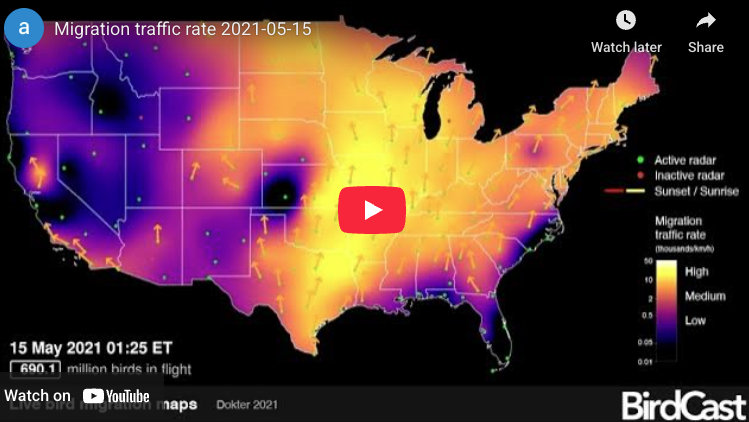
During the past week, enormous numbers of birds have been migrating through the US. A review of our live migration maps, in particular the night of 14-15 May, confirm several nights well above 400 million birds aloft!
 May 6, 2021Migration update: diurnal migration in the San Gabriel Mountains, California
Southern California affords some excellent opportunities to see continuing diurnal migration of typically nocturnal migrants. Kicking off in Spring 2021, the Bear Divide Migration Count by the Moore Lab of Zoology at Occidental College is one of these opportunities!
- May 6, 2021New Research: BirdCast takes flight in Alaska
For more than 50 years US radar aeroecology has largely been restricted to the lower 48 states — until now. Just out in the Proceedings of the Royal Society B, the BirdCast team publishes the first weather surveillance radar studies of Alaskan bird migration.
- May 5, 2021Caribbean Cruisers: visible migration along the Atlantic Coast of Florida
During the week of April 19-25, several weather events set up excellent conditions for observing visible migration, mostly of wood-warblers, including this Worm-eating Warbler, migrating along Florida’s east coast. Our colleague Jacob Drucker reports on his observations on the ground!
- April 30, 2021Migration Alert: trans-Gulf migration and precipitation
Trans-Gulf migrants are encountering rain as they approach the US coastline. Birders in Texas and in other areas along the Gulf of Mexico cost should make plans to visit the coast … now.
- April 30, 2021SongbirdSaver: protect birds from tower collisions with bird friendly lights in your community
Every year approximately 6.8 million migratory birds collide with communication towers in the United States and Canada. Non-flashing lighting is a primary factor in these collisions. Fortunately, there’s a unique opportunity for communications tower owners and birds to mitigate the hazards that such structures pose.
- April 29, 2021Species on the move: tanagers in the US during April 2021
Tanagers bring the most incredible splashes of color to spring migration across the continent. Check out the movements of three migratory species over the last month.
- April 26, 2021Observing nocturnal migration: Moonwatching on 26 April 2021
April’s Super Pink Moon will be visible after sunset and reach peak illumination at 11:33 P.M. EDT on 26 April 2021. For those wishing to see birds migrating at night, if the sky is clear, point a telescope or strong pair of binoculars toward the moon, particularly if you are in a location where the BirdCast model predicts medium to high intensity migration.
- April 24, 2021More slingshot potential for the Atlantic Seaboard from another strong frontal boundary
An evolving frontal boundary will make for some interesting conditions along the Atlantic Seaboard to transport birds farther afield than they might typically travel in the coming 72 hours.
- April 19, 2021Lights Out Texas, peak spring bird migration is here!
The spring window for peak bird migration in Texas has arrived, so it’s time to get outside and experience the coming spectacle! Just doing one simple thing will help protect these migrating birds: turn off all non-essential lights between 11pm and 6am every night to go Lights Out and reduce collision risk!
- April 16, 2021Migration alert: continuing impacts of Gulf of Mexico frontal boundaries
Continuing frontal boundaries and associated unstable weather conditions in the Gulf of Mexico are going to make for some interesting migration patterns in the coming week.
- April 16, 2021Weather radars’ role in biodiversity monitoring
The GloBAM research consortium published a letter in Science with a call for European national meteorological agencies to provide biological and meteorological data from its radars.
News
Scientific Team
BirdCast is made possible by the participating scientists at the below institutions, and many other contributors.