


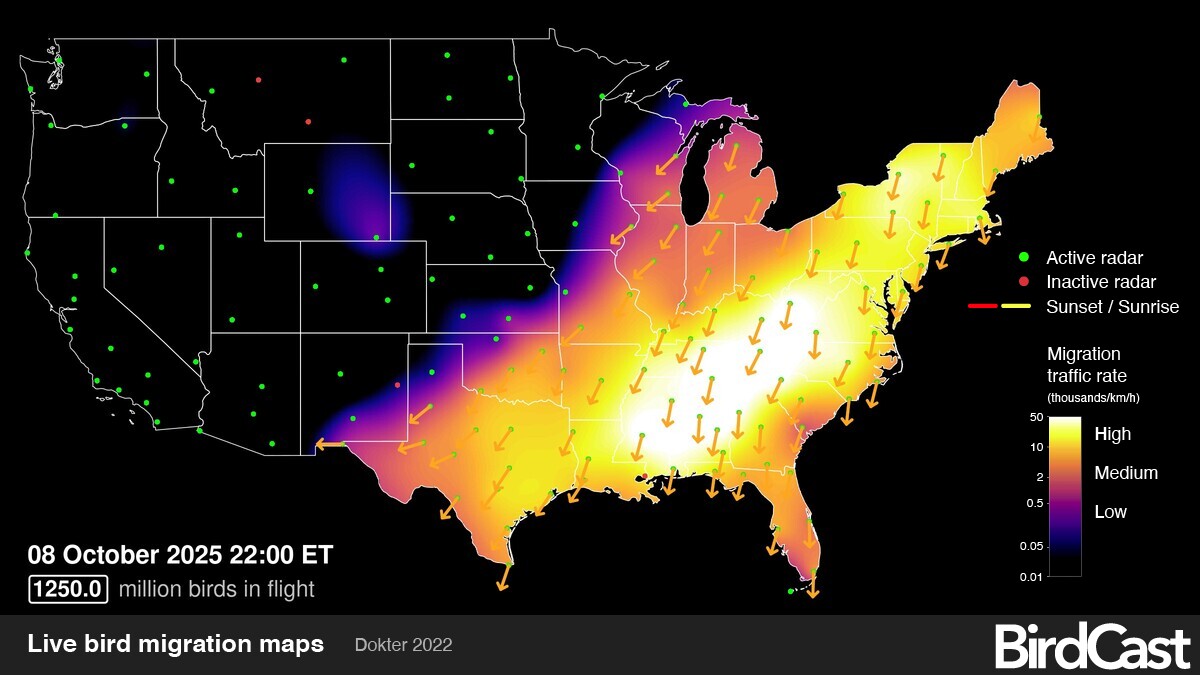
 October 8, 2025A new record night of migration for BirdCast! AGAIN!
We said BILLION twice before in BirdCast history, on 6 October 2023 and on 25 September 2025! Amazing! Welcome back to the billion bird night club! Again! For the third time! 8 October 2025! The third epic night did not stop at a billion either: no, it grew beyond that, and beyond 1.1 billion, beyond 1.2 billion, all the way to 1.25 billion, becoming the biggest night of migration yet recorded by BirdCast!
 June 7, 2021A new publication on drivers of fatal bird collisions in Chicago
The BirdCast team led a study published today that uses two decades of data to show that migration magnitude, light output, and wind conditions are important predictors of collisions at a high-profile building in Chicago. This research has global implications for conservation action campaigns aimed at eliminating an important cause of bird mortality: light pollution and resulting collisions with structures.
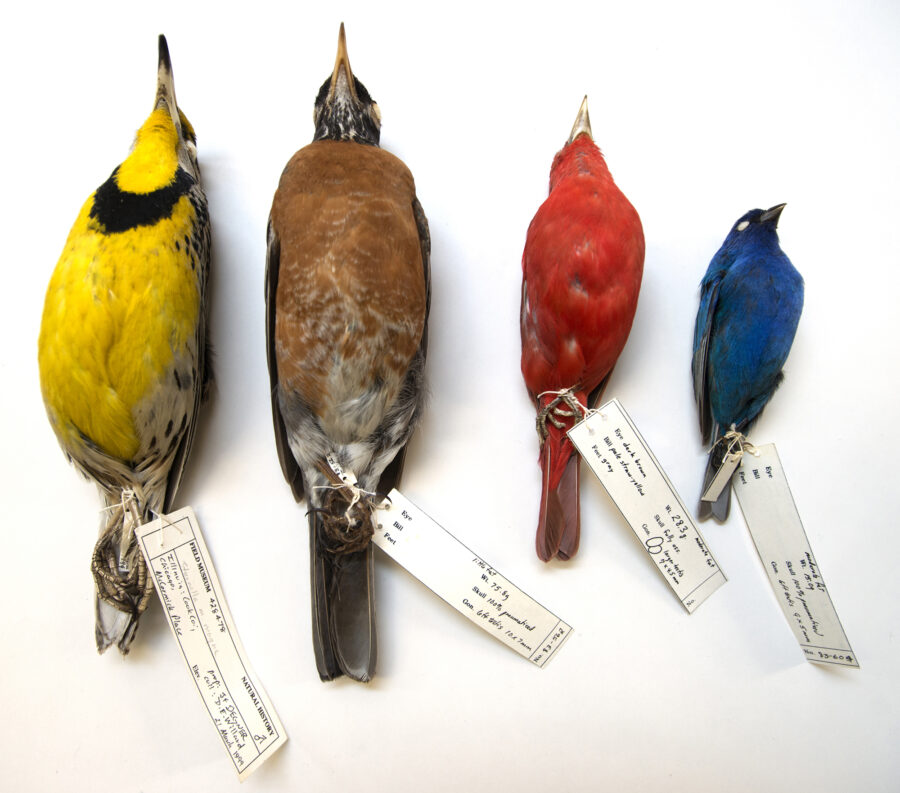 June 7, 2021A new publication on drivers of fatal bird collisions in Chicago
The BirdCast team led a study published today in PNAS that uses two decades of data to show that migration magnitude, light output, and wind conditions are important predictors of collisions at a high-profile building in Chicago.
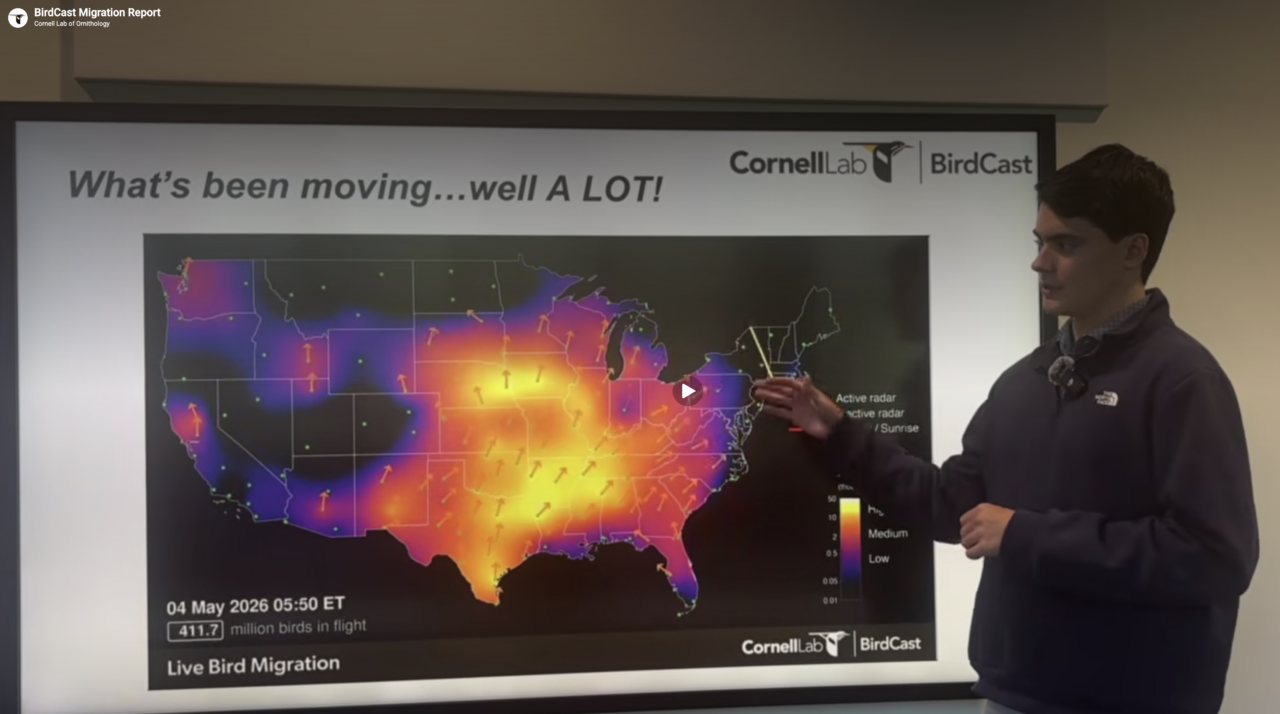 May 4, 2026A migration forecast gets the broadcast treatment!
Broadcast meteorology and BirdCast migration forecasts comes together – watch as we unveil one of the first pilot video forecasts!
- March 27, 2018A BirdCast welcome to a new era: Spring 2018 migration maps
BirdCast has been working toward automatically predicting and analyzing bird migration across the continental US, and we now unveil automated forecast maps and live migration maps. Welcome to the future of migration monitoring, please explore the new visuals and tune in frequently for discussion about movements!
- January 4, 2021A BirdCast Welcome to 2021
Welcome to 2021! Team BirdCast has a number of projects underway for this year. And although we are still a good 4-6 weeks from the first significant movements of mid to late winter migrants moving in the US, keen observers should be aware of several patterns to watch now.
- November 7, 2012A (new) NE Canada – Northeast US connection to end the week?
Today through Friday has potential to see winds transport waterfowl, gulls, and other late migrants and irruptives into the Northeast and Great Lakes. Additionally, snow cover may force sparrows and open-area species like pipits, longspurs, Snow Buntings, and larks to…
- May 8, 20158-15 May 2015 Regional Migration Forecast: Peaks and valleys
Favorable conditions for light to moderate flights begin and ends the period for the West as Black-bellied Plover, Lesser Yellowlegs, Willow Flycatcher, Swainson’s Thrush, Townsend’s Warbler, Virginia Warbler, and Blue Grosbeak are on the move, while the moderate to heavy flights that will include White-rumped Sandpiper, Short-billed Dowitcher, Least Flycatcher, Philadelphia Vireo, Blackpoll Warbler, Chestnut-sided Warbler, Wilson’s Warbler, Rose-breasted Grosbeak, Savannah Sparrow and White-crowned Sparrow navigate around some serious weather in the first half of the period and quiet markedly with that weather’s departure to end the period.
- June 1, 20183-day Forecast Maps return in the Fall: BirdCast breaks for summer 2018
Thanks for all the memories! BirdCast automated forecast and live migration maps for Spring 2018 will be deactivated until 1 August 2018 – the last forecast map was published for the night of 31 May 2018, and the last live migration map will post on 15 June 2018. Please check back often for additional comments and posts on the spring 2018 season and the arrival of the farm migration maps on 1 August!
- May 29, 201529 May-5 June 2015 Regional Migration Forecast
As the spring migration winds down for most species, this forecast period sees early week light to moderate movements in the West that feature Common Nighthawk, White-throated Swift, Warbling Vireo, Cedar Waxwing, and Gray Catbird and mostly moderate flights in the East that feature late season shorebirds, Least Tern, Yell0w-billed Cuckoo, Acadian Flycatcher, Alder Flycatcher, and Cedar Waxwing among other late season passerine migrants.
- June 5, 201529 May – 5 June 2015 Regional Migration Analysis: last gasp for spring 2015
All but the latest of migrants already passed, this week saw in the primarily scattered light and highly localized moderate movements across the West, with late migrants featuring Olive-sided Flycatcher, Willow Flycatcher, Cedar Waxwing, and Townsend’s Warbler, while the East saw its light to moderate flights concentrated in the center of the country and featuring primarily departures of Least Sandpiper, White-rumped Sandpiper, Short-billed Dowitcher, Cedar Waxwing, Swainson’s Thrush, Tennessee Warbler, Blackpoll Warbler.
- April 30, 201524-30 April Migration Analysis
Moderate movements, particularly in the latter half of the period from California and the Desert Southwest, included Spotted Sandpiper, Wilson’s Phalarope, Olive-sided Flycatcher, Western Wood-Pewee, Swainson’s Thrush, Yellow-breasted Chat, Western Tanager, and Black-headed Grosbeak in the West, while the migration machine kicked into a higher gear with moderate to heavy flights in the East that included Least Flycatcher, Philadelphia Vireo, Veery, Mourning Warbler, Bay-breasted Warbler, Black-throated Green Warbler, Yellow-breasted Chat, Rose-breasted Grosbeak, Dickcissel, Orchard Oriole, and Baltimore Oriole.
News
Scientific Team
BirdCast is made possible by the participating scientists at the below institutions, and many other contributors.