


 April 8, 2024Aeroecology of the 2024 eclipse
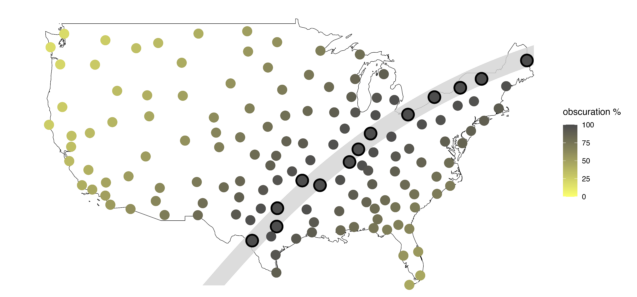
BirdCast will monitor ‘live’ the behavior of birds and insects during the total eclipse today. BirdCast’s ‘live migration maps’ will be enabled all day, and we have tuned the sensitivity to display the day-time activity of birds and insects combined. The eclipse display, the thumbnail you see to the right, will be active from 1pm to 5pm today.
 April 8, 2024Aeroecology of the 2024 eclipse
Follow the celestially-driven, aeroecological events of today’s total solar eclipse as detected by the weather surveillance radar network operating in the contiguous US! BirdCast will, again, monitor aerial animal behaviors during today’s eclipse from the perspective of what is happening to the numbers of animals above the contiguous US.
- September 13, 2020Active Week of Movements Ahead: High Intensity Migration and Tropical Systems
High intensity migration and evolving tropical systems are on deck for this week. We estimate movements 400-500 million birds on each of the coming nights over the continental US. Plus, a very active Atlantic Ocean Basin has a number of tropical systems of the move, entraining and displacing a diversity of birds in the Gulf of Mexico region and Bermuda.
- October 31, 2012Abridged Regional Migration Forecast: Eastern US 31 October – 4 November 2012
With the departure to the Northeast of Hurricane and Post-Tropical Cyclone Sandy, westerly flow prevails outside the Northeastern US across a huge portion of the Eastern US from the western Great Lakes through peninsular Florida. In many areas, despite the…
- July 23, 2020A tropical system may make landfall in Texas
A tropical system is building in the Gulf of Mexico, forecast to intensify in the coming days and then move ashore in central or southern Texas. Whether this system intensifies to hurricane strength or continues as a tropical storm or depression, it is likely to bring an array of seabirds ashore in southern and central Texas and possibly northern Mexico.
- April 9, 2013A spring overshoot discussion, continued, again . . .
Last week, Team BirdCast forecast that conditions looked favorable for spring overshoot migrants to occur in areas far to the north of their expected seasonal range. Here, we provide some additional discussion and speculation for what actually transpired. After a frontal…
- April 4, 2013A spring overshoot discussion . . . continued.
Several weeks ago, Team BirdCast highlighted a set of conditions for spring overshoot migrants, or “slingshot” migrants, to occur substantially farther north of their intended and seasonally appropriate destinations. We see potential for such conditions over the coming 24-48 hours,…
- March 6, 2013A spring overshoot discussion (but not necessarily a forecast!)
Although we are still quite early in the season to discuss the potential for a “slingshot” event that might cause typically southern spring migrants to overshoot their intended destinations along the Atlantic Coast, and although these events are relatively rare…
- September 12, 2024A primer for using weather surveillance radar to study bird migration
As a reminder to what the team is working on here at BirdCast, we return to a previous post we wrote. With spring soon arriving and preparations for migration underway, here is a primer on what we do. We turn weather radar data into information on the numbers and flight directions of birds aloft in order to expand the understanding of migratory bird movement. After several years (and hundreds of posts) describing migration, species on the move, and unique migration events, we want you to have a better understanding of what happens at BirdCast. Here is a brief overview and a behind-the-scenes look at the ways we apply radar data to study bird migration.
- April 4, 2018A Primer for New Migration Forecast Tools From BirdCast
Would you like more information on ways to use and to understand new BirdCast migration monitoring tools for spring 2018? Read on!
- September 8, 2021A picture is worth 500 million birds
The BirdCast forecast model predicts just over half a billion birds to be flying during peak flight hours tonight! Turn out your lights! Go birding!
 October 8, 2025A new record night of migration for BirdCast! AGAIN!
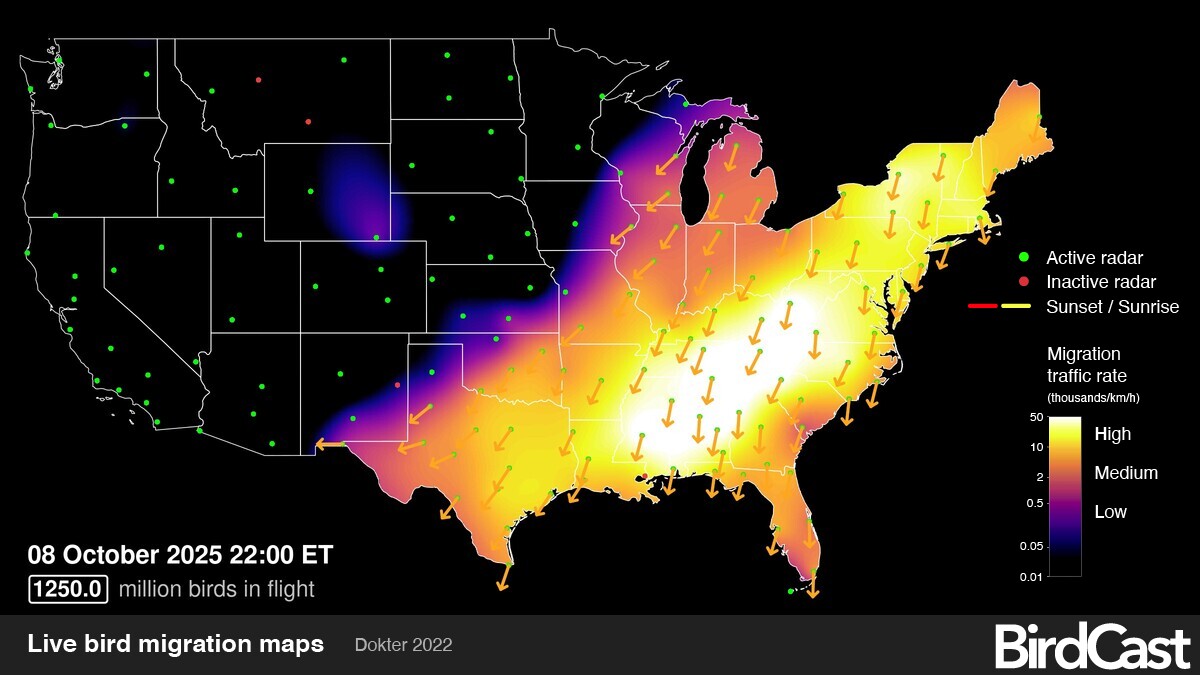
We said BILLION twice before in BirdCast history, on 6 October 2023 and on 25 September 2025! Amazing! Welcome back to the billion bird night club! Again! For the third time! 8 October 2025! The third epic night did not stop at a billion either: no, it grew beyond that, and beyond 1.1 billion, beyond 1.2 billion, all the way to 1.25 billion, becoming the biggest night of migration yet recorded by BirdCast!
News
Scientific Team
BirdCast is made possible by the participating scientists at the below institutions, and many other contributors.