


Regional Migration Analysis: 10-17 March 2017
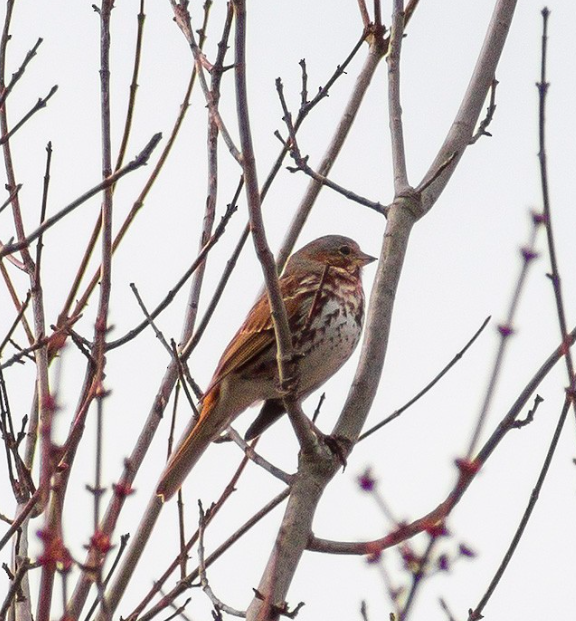
Fox Sparrow. Mike Bailey/Macaulay Library. eBird S35310036.
Continental Summary
Light to moderate flights in the West, primarily in California and the Desert Southwest, featured Black-chinned Hummingbird, Western Kingbird, Pacific-slope Flycatcher, Warbling Vireo, Wilson’s Warbler, and Hooded Oriole, while a mostly quiet and cooler East saw locally moderate movements featuring Swainson’s Hawk, Lesser Yellowlegs, Pectoral Sandpiper, Hooded Warbler, Fox Sparrow, and Chipping Sparrow.
Curious what birds will move next? Check out our forecast.
[animation name=”analysis-10-17-march-2017″]
Need a review of our definitions for regions, species on the move, and migration amounts? Please visit this link.
Quick Links to Regions
Upper Midwest and Northeast |
Gulf Coast and Southeast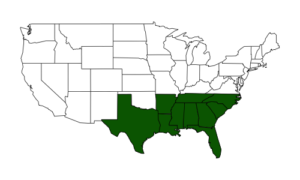 |
Great Plains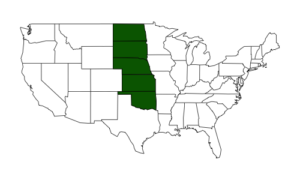 |
West |
Upper Midwest and Northeast
A quiet period for migration was dominated by the return of significant winter weather. A large storm dumped record snowfall on portions of the Northeast, while cool temperatures prevailed in many areas. Movements were locally light toward the end of the period in the central Mississippi River Valley, with the remainder of the region experiencing little if any significant flights. However, it should be noted that snow-induced movements were numerous, especially for areas New York and New England, where more terrestrial species like American Woodcock and numerous sparrows were concentrated in unprecedented numbers in urban areas like New York City.
Top Movers
[expand title=”Increasing” tag=”h3″]
[table sort=”,desc” tablesorter=”true”]
Species,Increase from Last Week[attr style=”color:green”],% of Checklists Reporting
Fox Sparrow,88%,12.3
Dark-eyed Junco,28%,44
White-throated Sparrow,29%,24.4
Brown-headed Cowbird,41%,9.3
Wilson’s Snipe,41%,2.7
American Tree Sparrow,22%,13.1
Rusty Blackbird,37%,3.1
Song Sparrow,13%,35.9
Horned Lark,22%,4.7
American Robin,8%,42.2
Blue-winged Teal,26%,1.8
Chipping Sparrow,34%,1.2
Carolina Wren,7%,16.2
Common Grackle,5%,25.3
Wood Duck,9%,8.2
Common Loon,15%,3.1
Lesser Scaup,6%,6.6
Lesser Yellowlegs,14%,0.3
Pectoral Sandpiper,13%,0.2
Great Blue Heron,3%,8.2
Eastern Phoebe,5%,3.7
Canvasback,5%,3
[/table]
[/expand]
[expand title=”Decreasing” tag=”h3″]
[table sort=”,asc” tablesorter=”true”]
Species,Decrease from Last Week[attr style=”color:red”],% of Checklists Reporting
Canada Goose,-18%,34.6
Mallard,-17%,28.1
Ring-necked Duck,-18%,9.3
Northern Harrier,-26%,2.6
Snow Goose,-31%,1.8
Bald Eagle,-16%,9.5
Common Merganser,-16%,8
Turkey Vulture,-13%,14.6
Ring-billed Gull,-11%,19.9
Eastern Bluebird,-11%,10.7
Fish Crow,-18%,3.9
Rough-legged Hawk,-39%,0.5
Field Sparrow,-22%,1.4
American Crow,-6%,41
Sandhill Crane,-16%,3
Gadwall,-11%,7.1
Laughing Gull,-32%,0.3
Herring Gull,-10%,11.8
Northern Pintail,-13%,3.8
Bufflehead,-8%,11.7
Green-winged Teal,-11%,6.6
Long-tailed Duck,-18%,1.4
Ruddy Turnstone,-34%,0.1
American Coot,-10%,5.4
[/table]
[/expand]

Hooded Warbler. Apolinar Basora/Macaulay Library. eBird S35163737.
Gulf Coast and Southeast
Locally moderate flights in Texas and Florida highlighted the weekend, while the remainder of the region stayed relatively quiet from a migration perspective. Tuesday and Wednesday nights saw slightly more extensive movements, particularly in Texas, where light to moderate flights were apparent. The greatest extent of movements occurred on Thursday night, when areas west of the Mississippi River and in Florida experienced light to locally moderate flights.
Top Movers
[expand title=”Increasing” tag=”h3″]
[table sort=”,desc” tablesorter=”true”]
Species,Increase from Last Week[attr style=”color:green”],% of Checklists Reporting
Barn Swallow,59%,8.7
Northern Rough-winged Swallow,59%,6.2
Black-chinned Hummingbird,108%,1.2
Louisiana Waterthrush,106%,1.2
Ruby-throated Hummingbird,56%,2.4
Cliff Swallow,96%,1.2
Tree Swallow,22%,14.1
Yellow-throated Vireo,83%,1.1
Couch’s Kingbird,37%,2.7
Black-and-white Warbler,29%,6
Purple Martin,21%,8.2
Scissor-tailed Flycatcher,89%,0.8
Swainson’s Hawk,215%,0.3
Black-necked Stilt,25%,2.8
White-eyed Vireo,10%,11.3
American Golden-Plover,66%,0.9
Hooded Warbler,287%,0.2
Hooded Oriole,129%,0.3
Golden-cheeked Warbler,82%,0.5
Blue-winged Teal,6%,11.3
Black-bellied Whistling-Duck,13%,4.6
Brown-headed Cowbird,7%,8.6
Black Skimmer,22%,2.3
[/table]
[/expand]
[expand title=”Decreasing” tag=”h3″]
[table sort=”,asc” tablesorter=”true”]
Species,Decrease from Last Week[attr style=”color:red”],% of Checklists Reporting
American Robin,-17%,19.7
Eastern Phoebe,-13%,19.4
Gadwall,-19%,5.3
Northern Pintail,-60%,0.5
American Pipit,-41%,0.8
Ring-necked Duck,-22%,4.1
American Wigeon,-24%,2.1
Ring-billed Gull,-12%,11.9
Song Sparrow,-11%,11.3
Pine Warbler,-9%,12.8
Green-winged Teal,-13%,4.4
Bufflehead,-11%,4
Fish Crow,-7%,17.4
Golden-crowned Kinglet,-13%,3.8
Herring Gull,-11%,3.7
Yellow-bellied Sapsucker,-8%,5.8
Redhead,-14%,1.8
American Kestrel,-7%,9.9
Eared Grebe,-22%,0.7
Double-crested Cormorant,-5%,23.7
Canvasback,-34%,0.3
[/table]
[/expand]
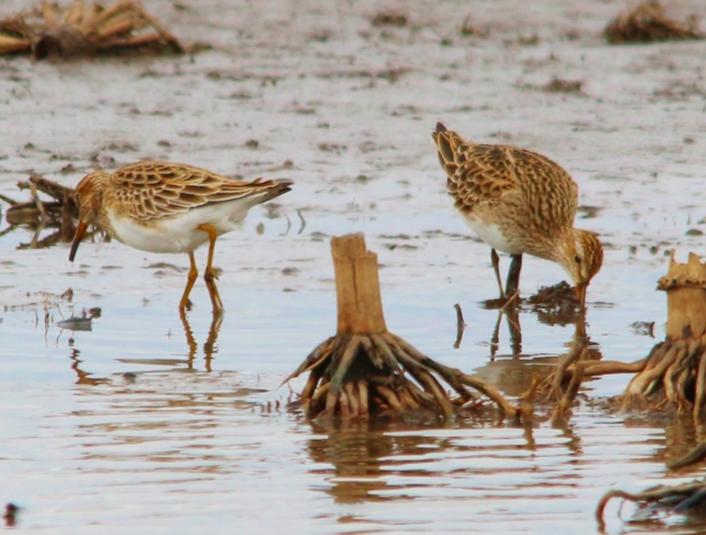
Pectoral Sandpiper. Rick Sammons/Macaulay Library. eBird S35363598.
Great Plains
The region generally experienced a quiet week, primarily a result of wintry weather passing through the region and cooler temperatures with northerly and westerly winds prevailing. But the end of the period, on Wednesday and Thursday nights, saw the southern Plains illuminated on radar. These movements were light, primarily, with isolated areas of more moderate amounts in southern Oklahoma.
Top Movers
[expand title=”Increasing” tag=”h3″]
[table sort=”,desc” tablesorter=”true”]
Species,Increase from Last Week[attr style=”color:green”],% of Checklists Reporting
Blue-winged Teal,90%,13.7
Lesser Yellowlegs,273%,2.9
Northern Shoveler,43%,21.2
Lesser Scaup,45%,15.9
Long-billed Dowitcher,209%,2.7
Green-winged Teal,42%,19.1
Ruddy Duck,46%,10.6
Western Meadowlark,45%,15.7
Gadwall,28%,26.4
American Pipit,114%,3.3
Turkey Vulture,48%,8.9
Savannah Sparrow,53%,6.1
Pectoral Sandpiper,291%,1.4
Greater Scaup,86%,3.6
Ring-necked Duck,29%,17.2
Cinnamon Teal,242%,1.4
Killdeer,23%,31.6
Wilson’s Snipe,84%,3.4
Greater Yellowlegs,61%,4.6
Great Blue Heron,27%,18
Fish Crow,117%,1.9
Double-crested Cormorant,30%,10.3
Least Sandpiper,101%,2.1
Bufflehead,23%,17.7
American Wigeon,24%,16
[/table]
[/expand]
[expand title=”Decreasing” tag=”h3″]
[table sort=”,asc” tablesorter=”true”]
Species,Decrease from Last Week[attr style=”color:red”],% of Checklists Reporting
Red-bellied Woodpecker,-15%,19
White-breasted Nuthatch,-21%,10.7
Brown Creeper,-40%,2.2
Carolina Chickadee,-22%,6.3
Tufted Titmouse,-18%,10.7
Downy Woodpecker,-13%,20.1
Rough-legged Hawk,-38%,1.8
Golden-crowned Kinglet,-38%,1.4
Dark-eyed Junco,-8%,38.7
Yellow-rumped Warbler,-16%,8.4
House Finch,-10%,18
Sharp-shinned Hawk,-37%,1.3
Carolina Wren,-10%,12.6
Hermit Thrush,-39%,0.7
Common Merganser,-17%,4.5
Red-headed Woodpecker,-25%,1.9
Canada Goose,-6%,40.9
Red-shouldered Hawk,-15%,4
American Goldfinch,-5%,17
Harris’s Sparrow,-7%,12.1
American Woodcock,-64%,0.2
Cackling Goose,-13%,4.9
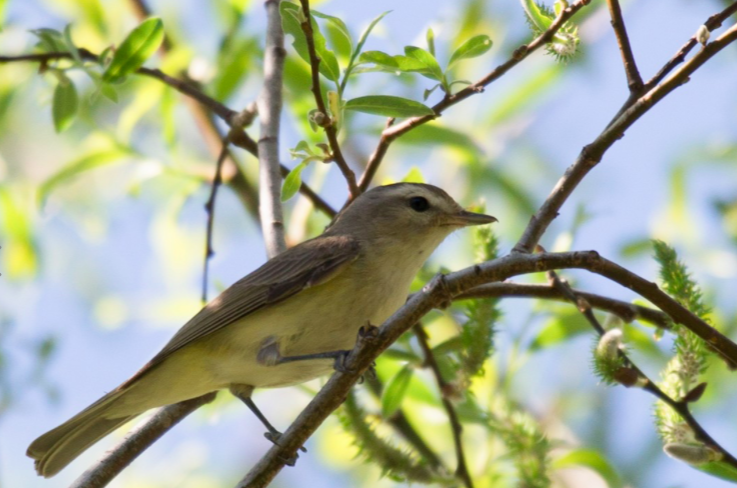
Warbling Vireo. Herb Elliot/Macaulay Library. eBird S35140266.
West
Light to moderate flights from the Pacific Northwest through the Desert Southwest kicked off the weekend. These movements became less extensive by Monday as unfavorable migration weather arrived in Washington and Oregon. California and the Desert Southwest continued to experience light to locally moderate flights through the period, with a return of locally light flights to the Pacific Northwest by Thursday night. Movements in the remainder of the region during this period were locally light.
Top Movers
[expand title=”Increasing” tag=”h3″]
[table sort=”,desc” tablesorter=”true”]
Species,Increase from Last Week[attr style=”color:green”],% of Checklists Reporting
Pacific-slope Flycatcher,208%,1.9
Rufous Hummingbird,69%,3.8
Hooded Oriole,122%,2.2
Black-chinned Hummingbird,157%,1.5
Wilson’s Warbler,181%,1.1
Western Kingbird,149%,1.4
Barn Swallow,57%,3.2
Violet-green Swallow,35%,5.7
Broad-billed Hummingbird,48%,3.2
Purple Finch,39%,3.7
Warbling Vireo,200%,0.6
Orange-crowned Warbler,22%,6.9
Broad-tailed Hummingbird,146%,0.7
Bullock’s Oriole,126%,0.9
House Wren,26%,4.4
Cliff Swallow,37%,2.5
Tree Swallow,13%,9.4
Painted Redstart,97%,0.8
Brown-headed Cowbird,29%,1.8
Hutton’s Vireo,16%,4.5
[/table]
[/expand]
[expand title=”Decreasing” tag=”h3″]
[table sort=”,asc” tablesorter=”true”]
Species,Decrease from Last Week[attr style=”color:red”],% of Checklists Reporting
Cackling Goose,-27%,3
Great Egret,-22%,6.2
Black Phoebe,-16%,15.8
Varied Thrush,-36%,1.1
Ring-billed Gull,-12%,8.1
Northern Pintail,-13%,5.5
Common Goldeneye,-11%,8.2
Bald Eagle,-11%,7.7
Brown Pelican,-24%,1.3
Osprey,-16%,1.9
California Gull,-11%,6.4
Lesser Scaup,-11%,6.2
Herring Gull,-19%,2
Glaucous-winged Gull,-12%,4
Eared Grebe,-14%,3.1
American Tree Sparrow,-23%,0.6
Say’s Phoebe,-7%,7.9
Marbled Godwit,-12%,1.7
Golden-crowned Kinglet,-9%,2.4
Horned Grebe,-4%,2.8
Common Loon,-4%,2
Tundra Swan,-4%,1.9
Brewer’s Blackbird,1%,7.1
[/table]
[/expand]
–––––––––––––––––––––––––––––––––––
Farnsworth and Van Doren
Scientific Team
BirdCast is made possible by the participating scientists at the below institutions, and many other contributors.