


Radar Ornithology
History of Radar Ornithology
Historically, most nocturnally migrating birds went unobserved – with darkness obscuring birds in flight and many species migrating hundreds of meters to several kilometers above the ground. With the invention of the first optical devices, like telescopes, that magnified observations, breakthroughs observing celestial and terrestrial scenes allowed keen observers to recognize that birds were flying at night, for example as observations of silhouettes crossing the full moon. By the early to mid 20th century, numerous advances in electromagnetic research and applications spawned a dramatic pulse of inventions that would be crucial for studying nocturnal bird migration. In particular, the breakthroughs in understanding how to apply newly understood (at the time) properties of physics in technologies for RAdio Detection And Ranging (i.e. radar, after usage by the U.S. Navy in 1940), and then to realize that such technologies had additional applications for ornithological purposes, allowed for the first explorations that suggested the intensity, extent, direction, speed, and altitude of nocturnal bird migration.
After the discovery that solid objects reflect radio waves (Heinrich Hertz in the 1880s) and the engineering that could refine the applications of this discovery (Christian Hülsmeyer in the early 1900s), it was no surprise that radar technology developed rapidly during the 1930s as a means to detect enemy aircraft. But from the earliest years of radar application for tracking aircraft, engineers and operators noticed patterns on their newly developed cathode ray screens and plan position indicators that confused them. These targets that radars detected did not correspond to any weather condition or aircraft and were dubbed “angels” in honor of their transient nature. Sorting out the identity of these “angels” was incredibly important, especially during wartime and essential military operations when ignoring a detection could be fatal. David Lack (an ornithologist) and George Varley (an entomologist), both skilled field observers, hypothesized that the returns could be caused by birds and determined that birds (specifically Northern Gannets, Morus bassanus) were the culprit. With the seminal publication of these findings in Lack and Varley (1945), so began the era of radar ornithology.
The first U.S. weather surveillance radar (WSR-1) operated in the late 1940s at the Washington, D.C. airport, followed quickly in the next decade by the next generation of radars (WSR-57) placed along the coastal Gulf of Mexico (beginning with a WSR-57 in Miami in 1959). With the development of a network of WSR-57s, ornithologists became increasingly aware of the capacity of radar as a tool for tracking bird migration. The awareness culminated in the foundational work of Dr. Sidney A. Gauthreaux using WSR-57 data to study trans-Gulf migration in Louisiana. Presently an operational network of over 140 weather surveillance radars provides coverage of the atmosphere above the contiguous US (and Alaska, Hawaii, and even Korea).
The technological advances of Next Generation Radar (NEXRAD, WSR-88D, the sensor monitoring U.S. airspace at present) in the 1980s, that followed the evolution from the WSR-1 to the WSR-57 and WSR-74, is what allowed the field of radar ornithology to truly take flight. The advent of digital technology and Doppler capabilities was game changing for meteorology and ornithology. Furthermore, in system upgrades in 2012-2014, a new feature to U.S. radars called “dual polarization” (dual-pol, for short)—pulses of microwaves emitted at two angles instead of one – further enhanced radars’ capabilities to track birds and discriminate different targets in the atmosphere. For meteorologists, dual-pol data provide an ability to distinguish partially frozen sleet from droplets of rain; for ornithologists, they allow us to more easily separate birds from precipitation and other flying creatures. The combination and WSR-88D features and upgrades led to a dramatic increase in the profile and credibility of radar to study bird migration at scales of kilometers to thousands of kilometers, and so, too, numerous publications ranging from basic natural history to hypothesis testing to conservation and commercial applications.
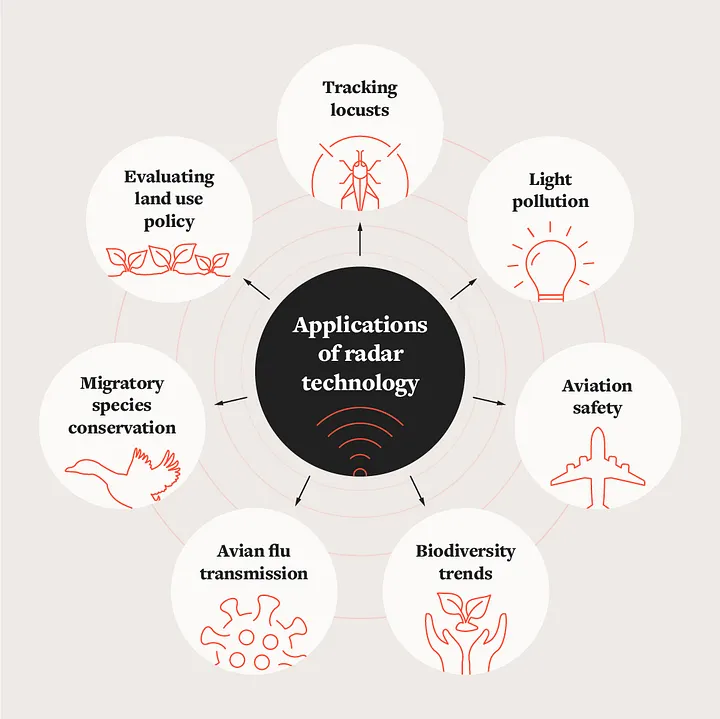
See this post from 2018 by Carley Eschliman and Kyle Horton to learn more about the various uses of radar. We also created cursory tutorials on radar ornithology background and application in 2013.
Applications of Radar Technology & Classification Distinction
Radar captures information about anything in the atmosphere that can scatter pulsed microwave energy it sends back to it. Meteorological phenomena share the sky with objects anthropogenic and biological phenomena, from aircraft and Saharan dust to hordes of mayflies and forest fire smoke plumes. Since the discovery of electromagnetic properties that underlie the applied technology, radar has become a valuable tool for studying all kinds of objects in the atmosphere.
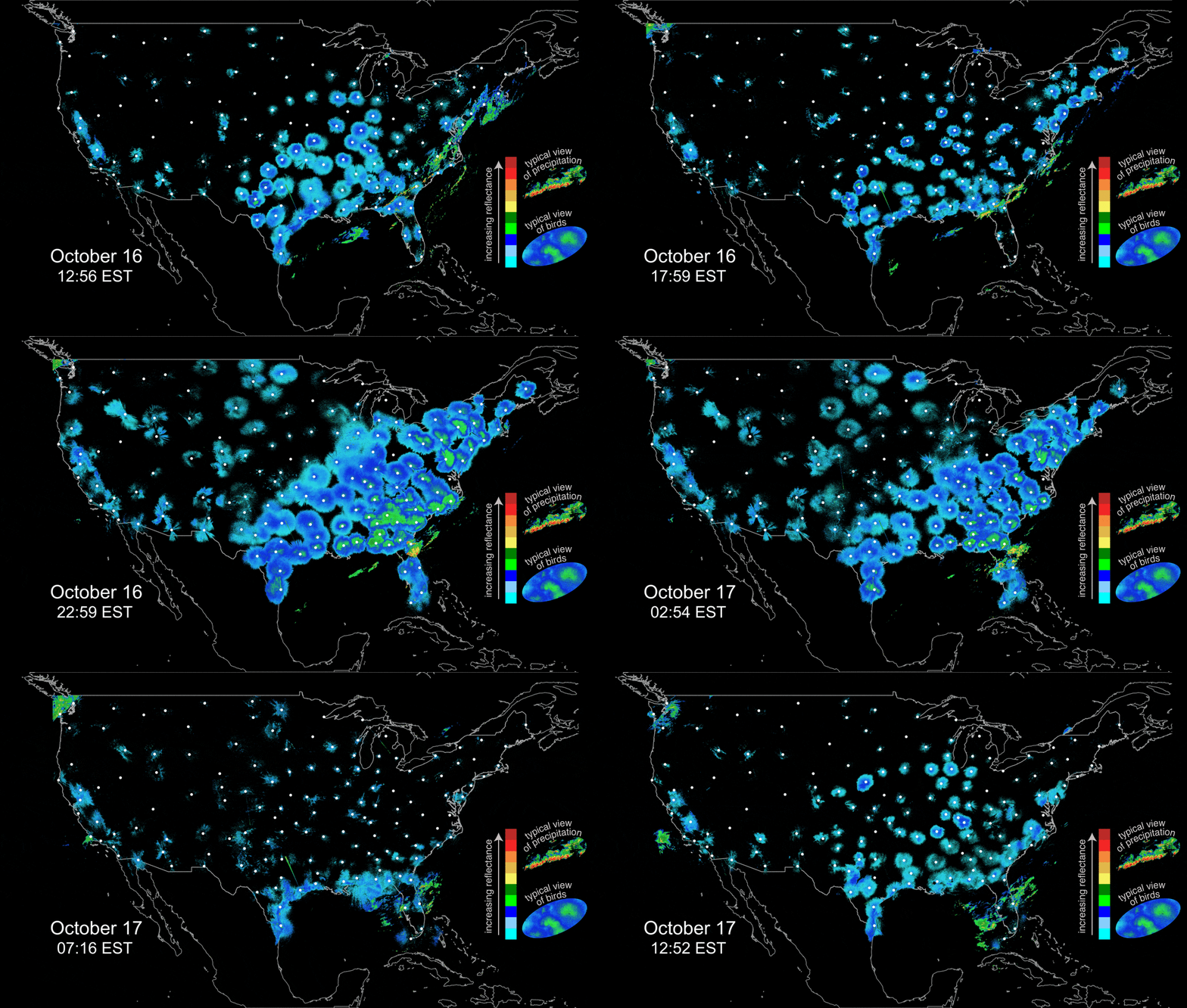
Here at BirdCast, we use archived weather surveillance data and machine learning to distinguish migrating birds from other objects in the atmosphere. We turn weather radar data into information describing the numbers and flight directions, speeds and altitudes of birds aloft in order to expand the understanding of migratory bird movements, especially those occurring at night.
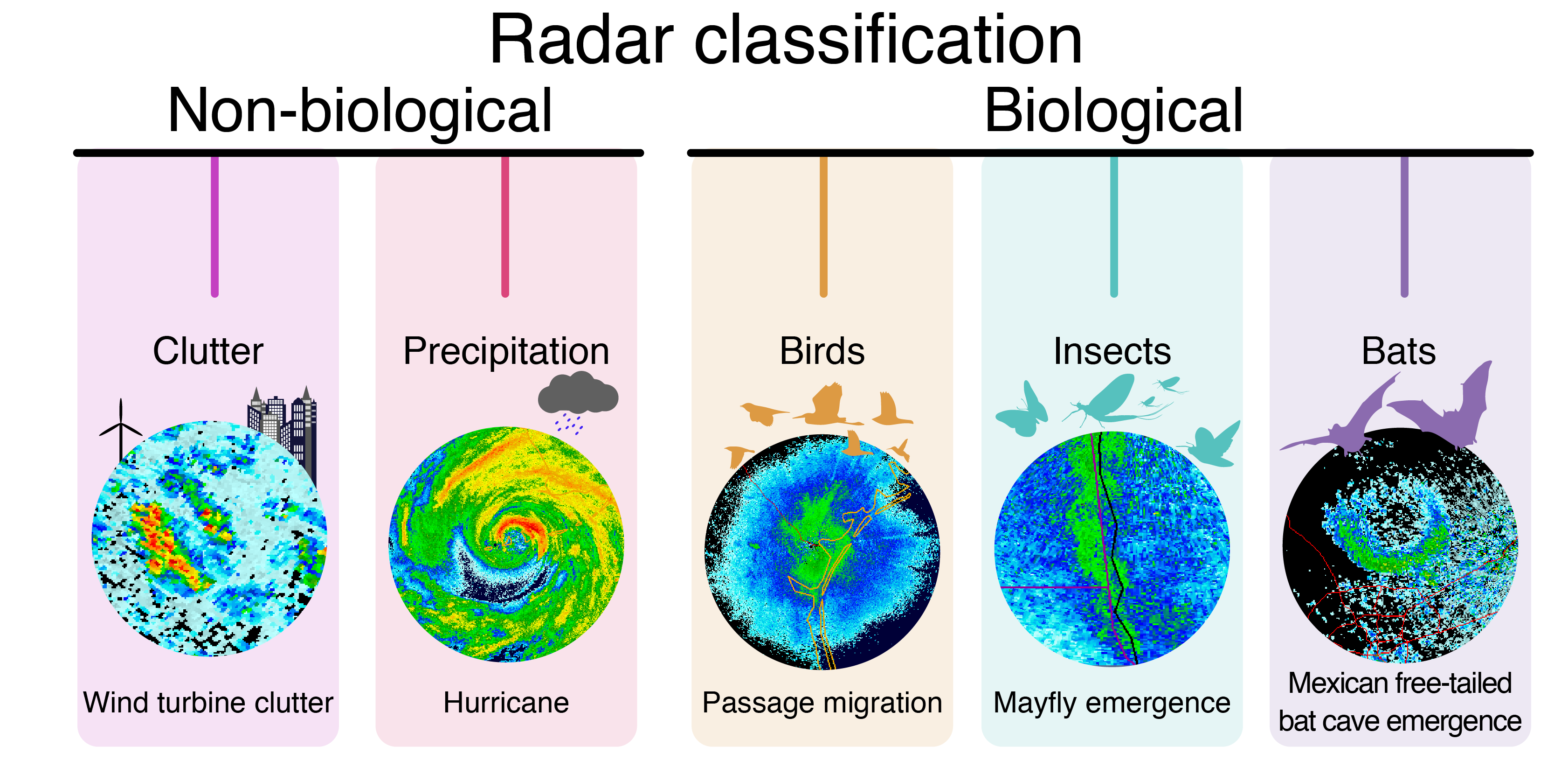
Non-Biological
Meteorological objects (rain, snow, sleet, and the like) are the most common targets found in radar data. Their detection is the primary goal of NEXRAD systems, and quality control filters have been created to remove distracting data. Such distractions include “false echoes” from ground clutter (wave reflections from nearby buildings/trees) and from waves bent towards the Earth’s surface (a somewhat rare phenomenon caused by changes in air temperature). False echoes have been muddying radar observations since the technology’s inception, and highly sophisticated algorithms can remove most of these echoes from the data.
Biological
Biological data—which is somewhat helpful to those tracking movements of the atmosphere but distracting to meteorologists—are not as easy to remove from radar data. Changes in time and space for airborne biology make automatic removal of returns from birds, bats, and insects challenging. However, these data are the primary currency of science for the BirdCast team! Using meteorologists’ “discarded” data, we meticulously attempt to characterize the biology of the atmosphere and to distinguish birds from insects and bats.
Birds
Birds can be distinguished by the size, shape, and intensity of radar returns. With the latest in processing capabilities allowing us to examine the entire archive of weather surveillance radar data for the U.S., we can look for the telltale signatures of bats emerging to forage from caves and map these to know these are not birds in the future. Species-specific behavior also assists in distinguishing birds from bats and insects.
For example, certain species of birds like Purple Martins are prone to assemble in massive nocturnal roosts before and during migration. When these birds take to the sky, their activity produces a unique “ring”; a similar ring is seen when thousands of bats leave a cave. However, by relying on our knowledge of when and where Purple Martins are—and other migratory birds with similar roost behavior— we can attribute certain rings to bats and other rings to birds.
Insects
Both insects and birds rely on winds to help enhance their flight, but insects—given their small sizes—are generally more reliant on a boost from the wind. As a result, most insects travel in directions more aligned with winds (e.g. they drift or travel with the wind). Birds, however, have the ability to propel themselves at higher speeds and across (and even against!) winds. As a result, radar targets that are moving in a different direction than winds can be more readily attributed to birds.
Bats
For bats, we have a bigger challenge—flight speed and behavior do not easily distinguish bats from birds. Luckily, many birds and bats follow well-documented schedules, providing us with information on where and when to look. Birds initiate migration activity around 30-45 minutes after local sunset during spring and fall, whereas many bats set out on their foraging flights during the summer months. As a result, seasonality plays a major part in the analysis of datasets. This is not a perfect way to distinguish birds and bats by any means. For example, during the spring in the southern U.S. large numbers of bats overlap in space and time with large numbers of birds. In most regions however, the numbers of migratory birds is substantially higher than that of birds, such that the contribution of bat migration can be largely ignored.
Scientific Team
BirdCast is made possible by the participating scientists at the below institutions, and many other contributors.