


24-30 April Migration Analysis

Black-throated Green Warbler © Ian Davies
Continental Summary
Moderate movements, particularly in the latter half of the period from California and the Desert Southwest, included Spotted Sandpiper, Wilson’s Phalarope, Olive-sided Flycatcher, Western Wood-Pewee, Swainson’s Thrush, Yellow-breasted Chat, Western Tanager, and Black-headed Grosbeak in the West, while the migration machine kicked into a higher gear with moderate to heavy flights in the East that included Least Flycatcher, Philadelphia Vireo, Veery, Mourning Warbler, Bay-breasted Warbler, Black-throated Green Warbler, Yellow-breasted Chat, Rose-breasted Grosbeak, Dickcissel, Orchard Oriole, and Baltimore Oriole.
Curious what birds will move next? Check out our forecast.
[animation name=”24-april-1-may-2015-analysis”]
Need a review of our definitions for regions, species on the move, and migration amounts? Please visit this link.
Quick Links to Regions
Upper Midwest and Northeast |
Gulf Coast and Southeast |
Great Plains |
West |
Upper Midwest and Northeast
A wave of cooler temperatures in the region kept a lid on migration for much of the period. Light to moderate movements were scattered locally across Great Lakes and Mississippi and Ohio River valleys early, with even more widely scattered light movements in New England during this window of time. By Tuesday and Wednesday, more moderate flights were apparent in the mid Atlantic states and into New England, but these events never expanded far beyond these areas. Although New York, New Jersey, and portions of New England saw some of these moderate flights to end the period, another weak disturbance passing through the Appalachians had already shut down or inhibited most movements elsewhere. A bit farther afield, some interesting European migrants appeared close to or just into the North American realm, including a Eurasian Hobby, European Golden-Plovers, and Black-tailed Godwit.
Top Movers
[expand title=”Increasing” tag=”h3″]
[table sort=”,desc” tablesorter=”true”]
Species,Increase from Last Week[attr style=”color:green”],% of Checklists Reporting
Yellow Warbler,114%,11.4
Gray Catbird,111%,8.7
Baltimore Oriole,328%,3.3
Wood Thrush,143%,5.2
Black-throated Green Warbler,209%,3.8
Great Crested Flycatcher,122%,4.3
Rose-breasted Grosbeak,308%,2.4
Orchard Oriole,154%,3.1
Chimney Swift,65%,10.8
Warbling Vireo,78%,4.6
Ovenbird,84%,5.4
Red-eyed Vireo,72%,4.9
Black-and-white Warbler,63%,7.1
House Wren,52%,12.7
Ruby-throated Hummingbird,78%,4.1
Northern Waterthrush,94%,2.6
American Redstart,122%,1.8
Eastern Kingbird,68%,4.6
Indigo Bunting,79%,2.5
Blue-headed Vireo,55%,5.4
Spotted Sandpiper,50%,5.2
Scarlet Tanager,90%,2.1
Common Yellowthroat,40%,8.3
Nashville Warbler,120%,1.2
Yellow-breasted Chat,258%,0.7
[/table]
[/expand]
[expand title=”Decreasing” tag=”h3″]
[table sort=”,asc” tablesorter=”true”]
Species,Decrease from Last Week[attr style=”color:red”],% of Checklists Reporting
Ring-necked Duck,-28%,3.9
Fox Sparrow,-39%,0.6
Dark-eyed Junco,-18%,11.8
American Tree Sparrow,-32%,1.2
Common Merganser,-27%,3.3
American Black Duck,-24%,2.8
American Wigeon,-28%,1.4
Hooded Merganser,-25%,3.2
Tundra Swan,-84%,0
Bufflehead,-14%,7.4
Horned Grebe,-27%,3.1
Greater Scaup,-37%,0.7
Green-winged Teal,-14%,4.6
Common Goldeneye,-37%,0.6
Gadwall,-16%,3.4
Pied-billed Grebe,-13%,6.4
Common Loon,-21%,5.1
Northern Gannet,-29%,0.3
Canvasback,-37%,0.4
Northern Shoveler,-12%,5.3
Snowy Owl,-74%,0
Little Gull,-69%,0
American Coot,-10%,7.1
Long-tailed Duck,-26%,0.6
[/table]
[/expand]

Bay-breasted Warbler © Ian Davies
Gulf Coast and Southeast
Widespread moderate to heavy migration took place, particularly on Saturday night along the entire Gulf Coast, as many concentrated and grounded birds and arriving trans-Gulf migrants took flight. This intensity and extent of migration did not continue unabated far into the work week, with a strong low pressure center ushering a wave of unfavorable conditions on Tuesday and Wednesday for all areas away from Florida and the southeastern coastal plain. With its departure and high pressure prevailing and moving east, moderate movements returned to much of the region on Wednesday night and increased in intensity for most of the region on Thursday night.
Top Movers
[expand title=”Increasing” tag=”h3″]
[table sort=”,desc” tablesorter=”true”]
Species,Increase from Last Week[attr style=”color:green”],% of Checklists Reporting
Magnolia Warbler,117%,7.5
Bay-breasted Warbler,126%,4
Chestnut-sided Warbler,46%,7.2
Veery,74%,4.2
Least Flycatcher,105%,2.6
Yellow Warbler,34%,10.8
American Redstart,33%,13.6
Dickcissel,36%,6.2
Blackpoll Warbler,29%,7.5
Philadelphia Vireo,60%,2.7
Bobolink,70%,2.2
Wilson’s Warbler,114%,1.8
Western Tanager,199%,0.8
Black-throated Blue Warbler,27%,6.8
Western Kingbird,36%,5.4
Spotted Sandpiper,23%,9.3
Mississippi Kite,31%,3.5
Mourning Warbler,827%,0.4
White-rumped Sandpiper,67%,1
Rose-breasted Grosbeak,14%,14.8
Gray-cheeked Thrush,35%,3.2
Canada Warbler,51%,1.5
Eastern Wood-Pewee,17%,8.7
Ovenbird,19%,10.2
[/table]
[/expand]
[expand title=”Decreasing” tag=”h3″]
[table sort=”,asc” tablesorter=”true”]
Species,Decrease from Last Week[attr style=”color:red”],% of Checklists Reporting
Cerulean Warbler,-54%,1.1
Sora,-37%,1.8
Worm-eating Warbler,-34%,3.8
Black Skimmer,-39%,2
Forster’s Tern,-28%,4.1
Willet,-24%,6.8
Red-breasted Merganser,-42%,0.8
Pied-billed Grebe,-31%,3.6
Brown Pelican,-21%,7.9
Orange-crowned Warbler,-31%,2
Short-billed Dowitcher,-31%,2.1
Northern Harrier,-47%,0.7
Yellow-bellied Sapsucker,-78%,0.2
American White Pelican,-35%,1.6
American Avocet,-33%,1.7
Marbled Godwit,-38%,0.9
Laughing Gull,-18%,14.9
Sanderling,-24%,3.2
Ruddy Turnstone,-28%,3.6
Snowy Egret,-17%,11.1
American Coot,-19%,7.6
Dunlin,-24%,2.6
Royal Tern,-20%,5.7
[/table]
[/expand]
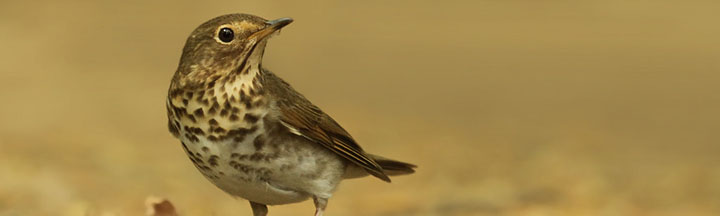
Swainson’s Thrush © Ryan Schain
Great Plains
A patchwork of light to moderate movements peppered the region for the first half of the forecast period, with weak disturbances and associated precipitation grounding birds in some areas. However, with the departure of these conditions to the east, Tuesday night saw the beginnings of more regional light to moderate flights. By Wednesday night migration had increased to more moderate levels in more areas, particularly in the southern Plains. And despite an approaching frontal boundary moving across the northern Plains, moderate to locally heavy movements bloomed in the central and southern Plains.
Top Movers
[expand title=”Increasing” tag=”h3″]
[table sort=”,desc” tablesorter=”true”]
Species,Increase from Last Week[attr style=”color:green”],% of Checklists Reporting
Baltimore Oriole,131%,9.9
Dickcissel,537%,2.8
Great Crested Flycatcher,95%,9.1
Swainson’s Thrush,129%,5.2
Western Kingbird,87%,9.5
Eastern Kingbird,54%,11.5
Summer Tanager,71%,5.2
Warbling Vireo,51%,9.6
House Wren,43%,13.3
Indigo Bunting,67%,4.7
Yellow Warbler,126%,2.5
Clay-colored Sparrow,84%,3.3
Bell’s Vireo,346%,1.3
Gray Catbird,144%,1.9
Forster’s Tern,43%,6.4
Least Flycatcher,252%,0.9
Sora,69%,2.9
Willet,21%,7.7
Long-billed Dowitcher,49%,4.2
Spotted Sandpiper,18%,11.4
Rose-breasted Grosbeak,149%,1
Chuck-will’s-widow,181%,1.2
Orange-crowned Warbler,24%,11.4
[/table]
[/expand]
[expand title=”Decreasing” tag=”h3″]
[table sort=”,asc” tablesorter=”true”]
Species,Decrease from Last Week[attr style=”color:red”],% of Checklists Reporting
Dark-eyed Junco,-41%,2.6
Hudsonian Godwit,-48%,2.3
Ruby-crowned Kinglet,-20%,8.2
Louisiana Waterthrush,-26%,3.2
Northern Harrier,-22%,4.2
Herring Gull,-78%,0.2
Franklin’s Gull,-34%,12.6
Fox Sparrow,-66%,0.2
[/table]
[/expand]

Yellow Warbler © Ryan Schain
West
Scattered precipitation kept migrants on the ground in a number of the recently hotter zones of migration for the weekend and early work week. But Monday night brought more favorable conditions, particularly from California into the Desert Southwest, where moderate movements occurred. These movements were more widespread on Tuesday night, not only in evidence in these areas but also along the eastern front of the Rockies. The end of the period mostly saw the extent and intensity of these flights continue from California east through the Rockies. Note that the Pacific Northwest did not experience much of a flight week, experiencing instead generality less favorable conditions for birds to move.
Top Movers
[expand title=”Increasing” tag=”h3″]
[table sort=”,desc” tablesorter=”true”]
Species,Increase from Last Week[attr style=”color:green”],% of Checklists Reporting
Wilson’s Phalarope,129%,2.9
Western Tanager,63%,6.6
Swainson’s Thrush,183%,1.5
Spotted Sandpiper,61%,5.9
Black-headed Grosbeak,51%,13.1
Wilson’s Warbler,30%,14.5
Yellow-breasted Chat,43%,3
Lazuli Bunting,38%,5.5
House Wren,32%,13.8
Yellow Warbler,30%,9.3
Brown-headed Cowbird,26%,15.1
Warbling Vireo,32%,7.2
Western Wood-Pewee,58%,1.9
Broad-tailed Hummingbird,41%,4.4
Western Kingbird,26%,12.7
American Goldfinch,22%,15.8
Plumbeous Vireo,43%,2.2
Townsend’s Warbler,27%,3.8
Brown-crested Flycatcher,43%,1.7
Bullock’s Oriole,26%,8.5
Eared Grebe,19%,6.1
Olive-sided Flycatcher,44%,1.5
Barn Swallow,16%,20.4
[/table]
[/expand]
[expand title=”Decreasing” tag=”h3″]
[table sort=”,asc” tablesorter=”true”]
Species,Decrease from Last Week[attr style=”color:red”],% of Checklists Reporting
Golden-crowned Sparrow,-24%,6.8
Green-winged Teal,-23%,7.5
Cackling Goose,-29%,1.4
American Pipit,-23%,1.9
Black-bellied Plover,-30%,1.3
Greater Yellowlegs,-20%,5.2
Bufflehead,-18%,7.4
Fox Sparrow,-27%,1
White-crowned Sparrow,-13%,19.4
Franklin’s Gull,-23%,1.9
Common Merganser,-14%,3.6
Pacific Wren,-16%,2.3
Merlin,-29%,0.5
Rough-legged Hawk,-56%,0.1
Ring-necked Duck,-11%,5.5
Long-tailed Duck,-90%,0
Horned Grebe,-16%,2
[/table]
[/expand]
–––––––––––––––––––––––––––––––––––
Farnsworth and Van Doren
Scientific Team
BirdCast is made possible by the participating scientists at the below institutions, and many other contributors.