


Warm Water, Northbound Birds: El Niño, Marine Heatwaves, and some Pacific Seabird Signals
In the company of the much of the world’s population, BirdCast has been watching El Niño develop for many months. Along the Pacific Coast of North America, birds have given us plenty to watch: among a long list of intriguing occurrences, a Red-footed Booby lingering at Race Rocks, British Columbia; Cocos Booby reaching the Columbia River and northern Vancouver Island; a Nazca Booby in Washington’s Salish Sea; numbers of Elegant Terns in Washington and Oregon; and Scripps’s Murrelets off Tofino. Many of these species are more regular in the waters off the southern California and Baja coasts. Their northern appearances, however, stand out, first as the vanguards beginning when California’s waters were already warm and then as main actors continuing into El Niño’s current phase of coastal and oceanic influences. Let’s dig in to various aspects of the story.
El Niño is strengthening: observations through mid-November
To begin, El Niño is the complex periodic warming of sea-surface temperatures in the central and eastern tropical Pacific, along with weakened trade winds. It is the “warm” phase of the El Niño–Southern Oscillation (ENSO) cycle and shifts weather patterns around the world, including rainfall, storm tracks and temperatures. NOAA’s ENSO Diagnostic Discussion, issued 12 November 2026 reports that El Niño strengthened in October 2026. Monthly relative sea-surface temperature indices rose to +4.4°C in Niño 1+2, off Ecuador and northern Peru; +3.6°C in Niño 3, extending west from near the Galápagos; and +2.5°C in Niño 3.4, farther west along the equator, well south of Hawaii. September’s values were +3.9°C, +3.0°C, and +2.1°C. The strongest warmth remains toward South America, but warming extends into the central equatorial Pacific. There is plenty of heat below the surface, too. In the eastern equatorial Pacific, temperatures at depth are locally more than +10°C above average, and the boundary between warm upper water and colder water below lies deeper than usual. Farther west, near the International Date Line, colder water has strengthened below the surface and spread east. NOAA’s 9 November assessment also noted slightly less excess heat in the upper ocean than in mid-October.
The atmosphere has joined the ocean
With all of the oceanic temperature movement, we also see atmospheric response. The usual east-to-west trade winds have weakened, while rising air, clouds, and rain have shifted toward the central and eastern equatorial Pacific. Indonesia has become drier. Strongly negative Southern Oscillation indices also reflect this change in tropical air pressure. Ocean and atmosphere are now working together as El Niño develops. Two ocean basin hurricane seasons offer indictments of the ENSO phase. By 7 November, the eastern Pacific had recorded 20 named storms, 10 hurricanes, and eight major hurricanes. The Atlantic had recorded 10 named storms and one hurricane through 6 November. That contrast fits El Niño’s usual influence, with the opposite pattern representing the opposite phase of the ENSO oscillation (La Niña).
But, suffice it to say, our detailed record-keeping on ENSO is rather short. The patterns of this fascinating and troublesome atmospheric and oceanic dance are complex. Tropical Pacific measurements span little more than a century, and satellite sea-surface temperature records date largely from the early 1980s. Corals and other evidence tell a much longer story of El Niño’s variation. And most interesting from the BirdCast team’s perspective is that, today, we can follow these ocean changes alongside the birds.
The birds have already told an interesting story
Much of the warmth off Southern and Central California preceded the actual moment that the climatological and meteorological communities said ” we have El Niño.” By March–April, large gatherings of Brandt’s Cormorants and Brown Pelicans between San Diego and Santa Barbara included sick and dying birds. State investigations identified starvation as a leading cause among birds examined. By NOAA’s 30 October assessment, coastal Kelvin waves appeared to be adding El Niño-related warmth. These waves change the depth of warm water, affect upwelling, and raise coastal temperatures and sea level. Along with tides and marine warmth, they contributed to unusually high California water levels in early November. Two large marine heatwaves also persist: NEP25A near California, dating to May 2025, and NEP26A farther offshore toward the Gulf of Alaska, dating to May 2026. Both had expanded or intensified by late October. And birds follow fish, squid, and other prey as these changing waters reshape feeding conditions, making birds alive, sickly, and dead, excellent proxies for tracking environmental conditions.
NOAA’s spring surveys captured part of this story. From 25 April to 8 June 2026, observers aboard the Rockfish Recruitment and Ecosystem Assessment Survey covered 3,825 km of the West Coast. Southern California was warm; upwelling kept nearshore northern California cooler. In the survey’s core area, Brown Pelican density was the highest in the 1996–2026 record, continuing a rise that began around 2018 (see the figure immediately below).
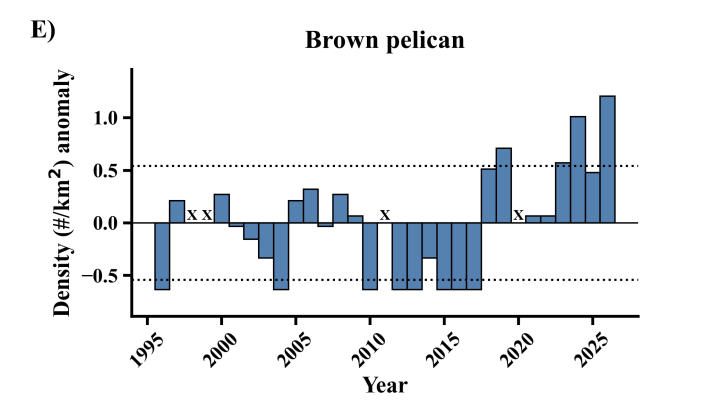
Elegant Tern density exceeded its long-term mean by more than one standard deviation.
Brown Pelicans and Elegant Terns normally move north, so high counts, in isolation, do not establish an El Niño response. But these surveys show that changes were underway in spring, before the tropical event matured. By September, San Diego pelagic trips were finding boobies and few Elegant Terns. A 5 September trip off San Diego recorded one Red-footed Booby, eight Cocos Boobies, one Nazca Booby, two Craveri’s Murrelets, 240 Black Storm-Petrels, and 70 Least Storm-Petrels, alongside 60 Brown Pelicans, 14 Heermann’s Gulls, and just five Elegant Terns. A similar route on 26 September produced Red-footed, Cocos, and Masked/Nazca Boobies (n.b. this can be a challenging identification), again with almost no Elegant Terns. Cocos Boobies occur year-round here; the scarcity of terns after a large nesting season was more striking. Farther north, central California’s Point Pinos Seawatch recorded an adult female Cocos Booby on 9 November and a subadult Masked/Nazca Booby on 10 November. Storm-petrels added other contrasts. Black and Least are regular off Southern California, while Leach’s and Townsend’s were reported closer to shore than usual. Least Storm-Petrels reached Humboldt County, with unusually northern reports of Black and Ashy Storm-Petrels as well.
Citizen science is filling in the northern edge
British Columbia’s interesting records stretch along Vancouver Island: Heermann’s Gulls in the north, Cocos Boobies around the island and Strait of Georgia, and two Scripps’s Murrelets off Tofino. The murrelets disperse north after breeding, but they are part of a striking mix this year in BC. Near Victoria, the Race Rocks Red-footed Booby was reported from 6 September through 15 October. Only British Columbia’s second documented record, it lingered for more than a month. And the out-of-range, northern seabird records continued into fall. Cocos Boobies appeared off Nanaimo on 6 October and at Vancouver Port on 1 November; Oregon’s 12 November bird alert still listed the Bonneville Dam bird. Nazca Boobies were documented around Smith Island in Washington’s Salish Sea and off Tofino in August. Together with California’s reports, these occurrences give us much more to consider than a single wandering bird, especially given their extended latitudes. These observations, as has been the case with all sorts of crowd-sourced information, provide powerful insight into birds’ distributions in a dynamic and timely way that was previously impossible to capture.
Not just one booby
There is precedent to the Sulid condition we now see. Russell et al. (2025) found that five Sula species increased in abundance in the California Current after marine heatwaves began in late 2013, with estimated increases of 692–3,015%. Their 2002–2022 study also documented northward expansions approaching seven degrees of latitude in some species. For Cocos and Red-footed Boobies, northern records were associated with warm water around southern Baja California a month earlier. Masked/Nazca Boobies showed relationships over other areas and periods. One possible sequence is simple: southern waters change, feeding conditions shift, and birds move. Some may be thinking, “wait!” Blue-footed Boobies have been a conspicuous exception in 2026, and Magnificent Frigatebirds have also been scarce. This intriguing patterns presumably requires its own future post, some conjecture, and some serious research.
More than boobies
Elegant Terns offer a parallel. Studies at Isla Rasa and Southern California colonies linked nesting shifts to warm water in the Gulf of California. In several years when temperatures in the Gulf’s Midriff region exceeded average by +1°C, more than 70% of the combined nesting population was in California. In San Diego this year, large numbers nested successfully in spring and early summer, then few remained into fall. More extensive northward dispersal is a plausible explanation. Farther north, nearly 200 Elegant Terns gathered near Westport, Washington, in early September. Point Pinos continued to record them into November, with 113 on 9 November and 13 on 12 November. Northward movement after breeding is normal; the contrast with San Diego’s late-season scarcity is what makes this year’s pattern interesting.
Other species may tell different stories. Few juvenile Heermann’s Gulls raised questions about breeding success at Isla Rasa. Guadalupe and Scripps’s Murrelets were conspicuous off northern California, within their known or plausible post-breeding movements. At Point Pinos Black-vented Shearwater counts reached 811 on 9 November and 970 on 11 November, when the counter also noted very few alcids. These birds feed in different places and on different prey. Their combined movements may offer a fuller view of the changing ocean than any one rarity, per se. The differences matter, the magnitudes matter, and the species matter. Warm water does not bring the same response from every species, as the scarcity of Blue-footed Boobies and frigatebirds reminds us.
And perhaps seabird movement from another direction
Warm water extends well beyond the equatorial Pacific. Marine heatwaves occupy parts of the western and northern North Pacific, as well as the large offshore area in the Northeast Pacific. Those waters can reshape feeding conditions across a vast area. Could some unusual seabirds reach our coast from the western or central North Pacific, rather than moving north from Baja California? It is an intriguing possibility, and highly likely when it comes to the appearances and distributions of some species. The California Current sits within a Pacific experiencing several warm events at once, and of course, El Niño is one component of that larger system.
Are the birds predicting El Niño?
No. The birds are responding. The ocean changed first. Birds show us how ocean changes may be impacting food and feeding.
But their movements can become conspicuous before some of our remote sensing infrastructure including satellites and buoys record changes that achieve a specific agency or research-based criterion for an ENSO event. This year’s sequence (2026) began in spring: warm Southern California waters, large pelican and tern counts, then the summer and fall northern expansion that followed. By mid-November, El Niño – now arrived officially – continues to strengthen. Its peak timing, extent, and intensity remain uncertain. And species are on the move beyond the bounds of their typical distributions.
Of course, there is a troubling side to this sequence: International Bird Rescue reported 358 Common Murre admissions from 15 August through 12 November: 286 in Northern California and 72 in Southern California, up from 312 total through 30 October. The rescue response began in March with starving pelicans, cormorants, and murres. Food shortages and disease are complicit in the simplest explanation for these losses, almost certainly part of the larger ecosystem level responses to ENSO patterns: warmer waters mean less food and better conditions for marine diseases to propagate.
For birders and careful observers, there is plenty to watch this winter: where birds gather, how long they stay, which species are absent, and where and when birds are in distress in coastal areas. And this discussion is specific, for now, to seabirds and to the Pacific coast of North America – there’s a global array of patterns to discuss in future posts. Furthermore, El Niño is still developing, and the birds’ movements and fortunes will give us more to follow in the months ahead. For example, this year saw Lesser Frigatebird observations from the Pacific and Atlantic coasts of North America, and even in the Great Lakes! Is this an ENSO connected event? Maybe.
What records are still to come, and what impacts bird distributions in the Pacific Ocean might manifest, we will see soon enough. As always, birds continue to move.
Scientific Team
BirdCast is made possible by the participating scientists at the below institutions, and many other contributors.