


 September 12, 2024A primer for using weather surveillance radar to study bird migration
As a reminder to what the team is working on here at BirdCast, we return to a previous post we wrote. With spring soon arriving and preparations for migration underway, here is a primer on what we do. We turn weather radar data into information on the numbers and flight directions of birds aloft in order to expand the understanding of migratory bird movement. After several years (and hundreds of posts) describing migration, species on the move, and unique migration events, we want you to have a better understanding of what happens at BirdCast. Here is a brief overview and a behind-the-scenes look at the ways we apply radar data to study bird migration.
- September 11, 2024Entrained and displaced birds associated with the passage of Francine
Francine made landfall in Louisiana, now making its way north along the lower Mississippi River valley. Its circulation has entrained some pelagic birds, displaced some nearshore species, and downed overland migrants.
- August 8, 2024Hurricane/Tropical Storm/Tropical Depression Debby: entrained, displaced, and downed birds in the eastern US
Debby arrived to Florida, meandered its way into the Carolina Bight, made landfall in the Carolinas, and is now rapidly speeding toward the northeastern portions of the continent. This storm, though not powerful in terms of winds, has produced large amounts of precipitation in its path and its wake. It’s also entrained some pelagic birds, displaced some nearshore species, and downed overland migrants.
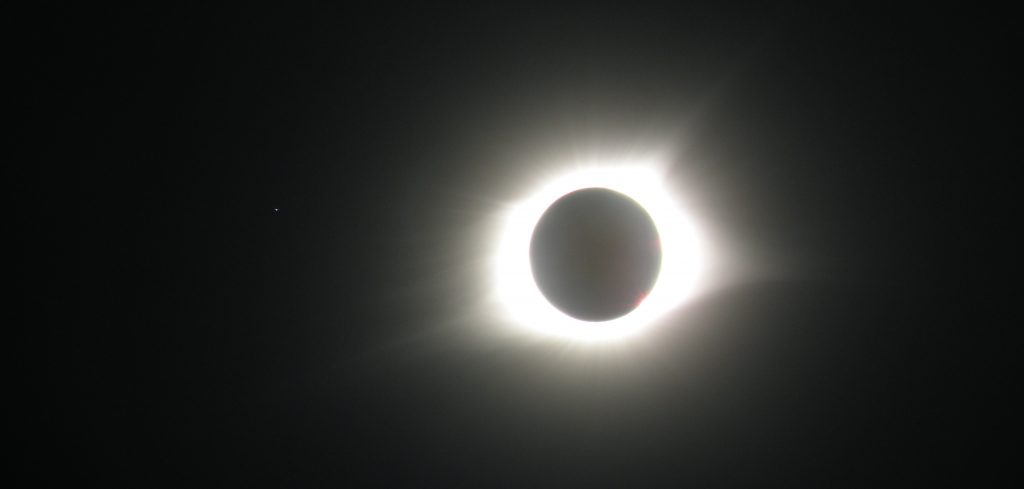 April 12, 2024Revisiting 2017, Part 2: What Did Birds & Insects Do During the 2017 Solar Eclipse?
In August of 2017, millions peered through protective eyewear at the solar eclipse—the first total eclipse visible in the continental United States in nearly 40 years. During the event, researchers from the Cornell Lab of Ornithology and the University of Oxford watched radar to observe the behavior of birds and insects. Their findings have been published in Biology Letters.
- April 9, 2024Peak Spring Bird Migration Periods for U.S. Cities
Spring migration is in full swing, and knowing when peak migration will occur in your area is valuable information! Here we provide a sortable table of peak periods of spring bird migration for the largest cities by human population size in the contiguous US.
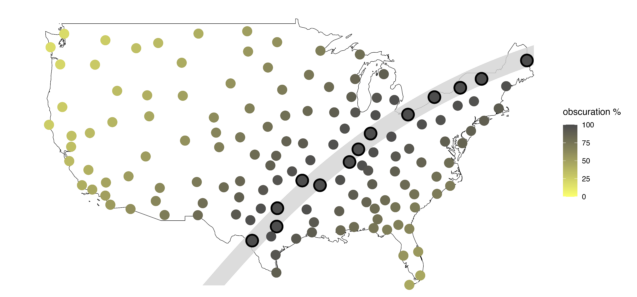 April 8, 2024Aeroecology of the 2024 eclipse
Follow the celestially-driven, aeroecological events of today’s total solar eclipse as detected by the weather surveillance radar network operating in the contiguous US! BirdCast will, again, monitor aerial animal behaviors during today’s eclipse from the perspective of what is happening to the numbers of animals above the contiguous US.
- April 8, 2024Aeroecology of the 2024 eclipse
BirdCast will monitor ‘live’ the behavior of birds and insects during the total eclipse today. BirdCast’s ‘live migration maps’ will be enabled all day, and we have tuned the sensitivity to display the day-time activity of birds and insects combined. The eclipse display, the thumbnail you see to the right, will be active from 1pm to 5pm today.
 April 5, 2024Revisiting 2017, Part 1: What Did Birds Do During a Total Eclipse? Observations from eBird and Radar on August 21, 2017
With the total solar eclipse of 8 April 2024 close at hand, we are highlighting a previous BirdCast new item describing behaviors observed during the 21 August 2017 total solar eclipse. See below to review the original post to get reacquainted with some of the behaviors we expect to see and, so, too, to get excited about observing behaviors on 8 April!
- April 5, 2024Revisiting 2017, Part 1: What Did Birds Do During a Total Eclipse? Observations from eBird and Radar on August 21, 2017
The BirdCast team will be reposting two accounts originally written about the August 2017 eclipse. This is the first of these posts, detailing reports of animal behaviors, which we hope will get you excited about observing animal behaviors on 8 April 2024!
- April 5, 2024Revisiting 2017, Part 2: What Did Birds & Insects Do During the 2017 Solar Eclipse?
The BirdCast team is reposting two accounts originally written about the August 2017 eclipse. This is the second of these posts, detailing results from our 2018 publication using radar to study biological activity in the air during the eclipse … with radar!
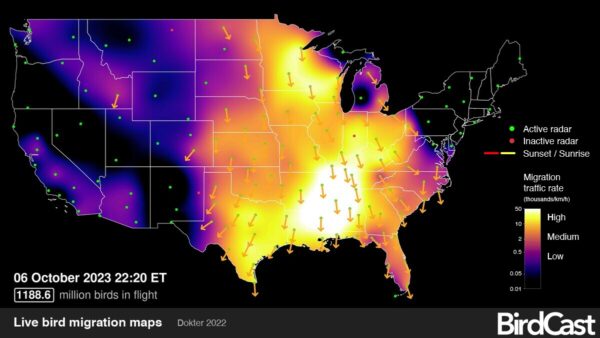 March 1, 2024The first BILLION bird night: 6-7 October 2023
We will keep this simple – welcome to the billion bird club!
There is not much more that we can say beyond – in the recorded history of BirdCast, here is the first billion bird night! BILLION! And, as you can see, this epic and grand occasion did not stop at a billion, growing to nearly 1.2 billion!- March 1, 2024The first BILLION bird night: 6-7 October 2023
Migration intensity goes off the charts – the BILLION bird barrier is shattered!
News
Scientific Team
BirdCast is made possible by the participating scientists at the below institutions, and many other contributors.