


New Methods Make Tracking Individual Species During Migration Possible
Kathi Borgmann
New approaches bridge gap between radar monitoring and species identification, advancing conservation efforts for birds during migration
Tools to track bird migration have helped people see migration as it’s happening, lighting up maps of the United States in brilliant yellows and oranges as birds migrate on the way to their breeding grounds. BirdCast shows vast numbers of birds on the move, but until now researchers have been unable to identify individual species. Researchers at Cornell Lab of Ornithology, University of Massachusetts, and University of Illinois have developed new methods to track migration of individual bird species combining the power of participatory science data with weather radar technology to create a comprehensive system to monitor the flights of individual species as they migrate across North America. This new research is part of the BirdFlow project, a project from the Cornell Lab of Ornithology and the University of Massachusetts that uses a probabilistic modelling framework to predict movements of bird populations during migration using data from the Cornell Lab of Ornithology’s eBird Status & Trend project.
The first new method the team developed is called BirdFlow Migration Traffic Rate (BMTR) that uses data from over 2 billion bird observations submitted by citizen scientists to eBird to provide species-specific estimates of migration patterns across North America. The study, published in the journal Global Ecology and Biogeography, analyzed migration patterns of 312 birds that migrate at night, traveling from their wintering grounds in Central and South America to the United States and Canada to breed.
A second paper, published in the journal, Movement Ecology, demonstrates how BirdFlow models incorporate data from individually tracked birds (GPS, Motus, banding) to reconstruct how bird populations move across the continent as they move to and from their breeding and nonbreeding grounds.
Together these two papers describe a new suite of methodologies that can vastly improve what we know about what species are migrating and how they move across the landscape, aspects that are critical for protecting migratory birds.
Filling Critical Gaps in Migration Monitoring
Migratory birds are difficult to study because most species cannot be tracked across all the places they occur, and individual tracking data are sparse, expensive, and often limited to a few groups of birds. These studies address this gap by combining weekly eBird Status & Trends abundance maps with multiple sources of individual movement information, including bird banding recoveries, Motus radio telemetry, radar data, and GPS tracking data.
The first model the team developed allowed them to estimate movement patterns for individual species at a given location throughout the year by combining eBird Status and Trends data with BirdFlow models. To test the validity of their model they examined 312 nocturnal migratory bird species. The new model successfully identified major flyway patterns along the Mississippi and Central Flyways and provided individual species migration estimates on a weekly basis even in areas with gaps in the weather radar network.
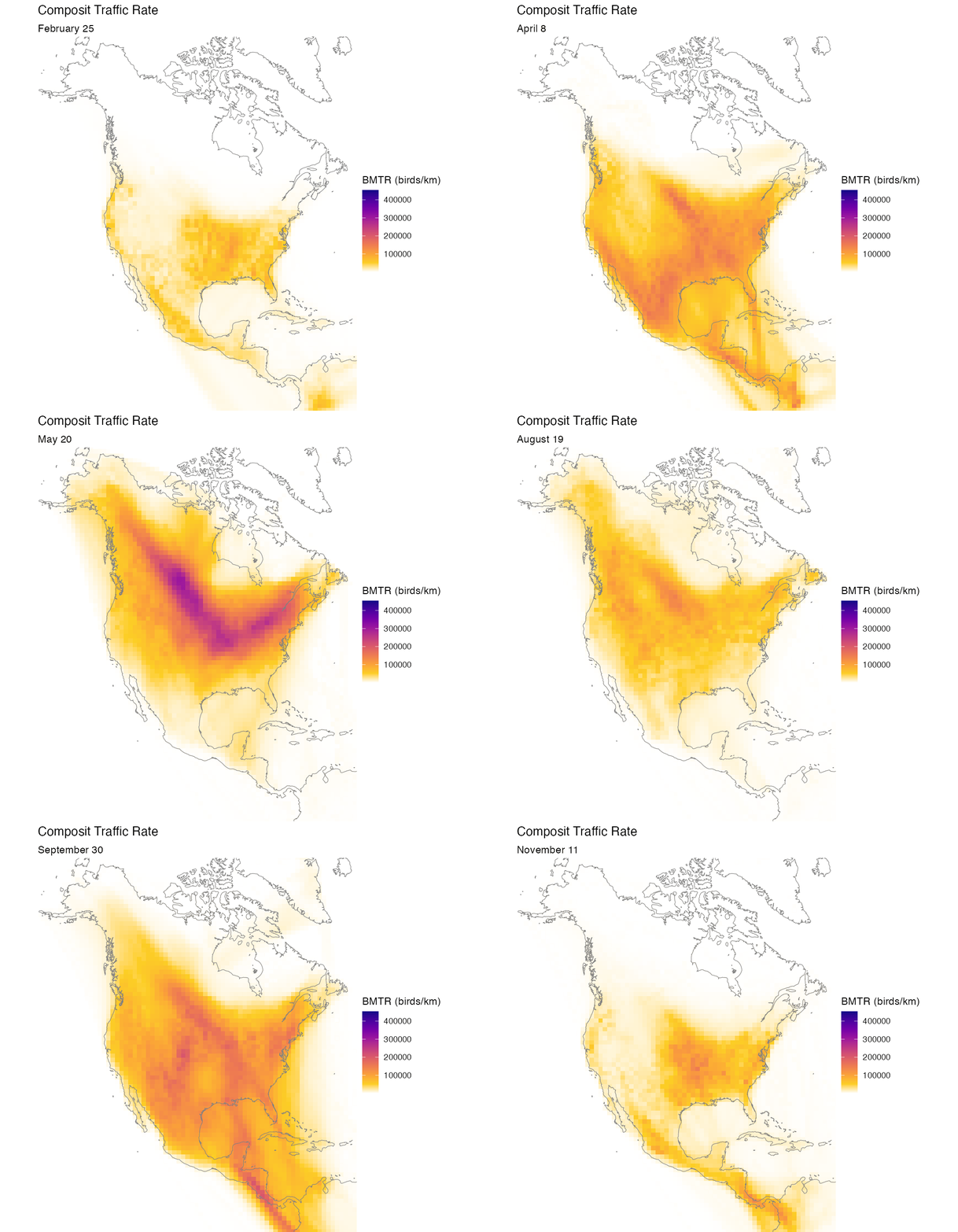
These methods offer several advantages over existing monitoring approaches. BMTR provides coverage in areas without radar infrastructure and enables species-specific monitoring at weekly resolution across entire species ranges. Unlike radar data, which provides near real-time monitoring, BirdFlow offers a 10-year average representation of migration patterns that can be combined with live radar feeds.
“BirdFlow opens up exciting new directions for monitoring and forecasting bird migration in real-time, as we already do in the BirdCast project with radar,” said Adriaan Dokter, project leader for BirdCast and BirdFlow at Cornell Lab. “The new BMTR metrics allow us to estimate the most likely species responsible for the movements we detect with radar, which detects the numbers of birds migrating aloft but not which species. In that way we combine the best of two worlds, the real-time monitoring by radar with species information provided by eBird and BirdFlow.”
Next, the team compared BirdFlow-derived migration estimates with 28 years of data from 152 weather surveillance radars across North America and found a strong correlation, validating the new method’s accuracy.
Given that the model performed well, the team then fine-tuned population-level migration models for 153 North American migratory bird species, spanning 14 orders and 39 families. These models predict where populations are likely to move from week to week, allowing researchers to estimate migration routes even for species that lack extensive tracking data. The new models were able to predict the migration routes of birds between different areas, something that is not possible with maps of species abundance alone. The team also showed that BirdFlow-generated migratory routes are biologically realistic when compared with real GPS-tracked birds.
“We find that incorporating such individual and species-specific differences—as captured directly by tracking and banding data—greatly improve our population-level movement models. We like to think of BirdFlow as a way of synergizing all the available information on the movements of individual species that is out there, and provide the best possible estimate for the movements and routes for the full species population,” said Dokter.
“These studies are unique because they can generalize the limited data we have from individual tracking studies, and create a scalable framework for modeling population-level movement across the continent,” said Yuting Deng, a postdoctoral associate at the Cornell Lab of Ornithology who was a part of both studies. “It also provides a practical path for improving models for data-limited species by transferring information from related species when species-specific movement data are unavailable.”
Advancing Bird Conservation
The innovation has immediate applications for bird conservation, particularly in reducing collision risks during peak migration periods. “Different bird groups are prone to different levels of risk of colliding with windows,” said Deng. “Especially small songbirds are prone to attraction to artificial light at night and subsequent collisions with buildings. Therefore, if we can identify nights with strong movements of collision-sensitive species, we will know when the risk for fatal collisions is highest. This allows us to create more species-specific conservation messages when we’re trying to advocate for lights out during peak migration windows for specific bird groups.”
The method also shows promise for tracking disease spread. Agencies and researchers are collaborating with the research team to use BirdFlow models for monitoring avian influenza transmission routes, particularly for waterfowl species. “By resolving these population-level movements, BirdFlow can support research and applications in migration ecology, conservation planning, disease surveillance, aviation risk assessment, and public outreach,” said Yangkang Chen, a PhD student at University of Illinois Urbana-Champaign, who lead the fine-tuning of the BirdFlow models.
These new methodologies also make it possible to study migration at a scale that was previously difficult: across entire species ranges, across the full annual cycle, and across hundreds of species. Understanding how migration varies is important because bird populations within the same species may use different routes, face different threats, and experience different environmental conditions.
Bridging Data and Technology
The BirdFlow project also published a new model collection for use with the BirdFlowR software to simulate migration routes and predict bird movement. This expands the number of vetted and individually trained models from 4 to 60. “This new collection of models will benefit researchers, the public, and conservation stakeholders who share an interest in these 60 species by providing comprehensive analytical and visualization tools to better understand their migration across the continent, guide conservation efforts, and project how environmental change may affect them,” said Chen.
Future Applications
The research team envisions integrating BMTR into existing monitoring systems like BirdCast, which currently provides migration forecasts but lacks species-specific information. The methodology could potentially expand worldwide given adequate citizen science data coverage, offering hope for global migration monitoring.
Reference
Plunkett, E., Deng, Y. and D. L. Slager, M. Fuentes, Y. Chen, B. M. Van Doren, A. M. Dokter, and D. Sheldon (2026). Novel Estimates of Bird Migration Traffic at the Continental Scale Using Participatory Science Data. Global Ecology and Biogeography https://doi.org/10.1111/geb.70236
Chen, Y. and D. L. Slager, E. Plunkett, M. Fuentes, Y. Deng, S. A. Mackenzie, L. E. Berrigan, D. Fink, D. Sheldon, B. M. Van Doren, and A. M. Dokter. (2026). Population-level migration modeling of North America’s birds through data integration with BirdFlow. Movement Ecology. https://doi.org/10.1186/s40462-026-00651-z
Scientific Team
BirdCast is made possible by the participating scientists at the below institutions, and many other contributors.